The fastest way to get the right item from an AI shopping agent is a brief that leaves nothing to guess: the exact item, must-haves, a total budget, a deadline, acceptable stores and a rule for when to stop and ask. Agents are good at searching and comparing, but they fill gaps with assumptions, and an assumption at checkout is a return later. This guide gives templates you can copy, based on how each agent's documentation says it shops as of November 2026. We have not tested these briefs on live purchases.
- Things every shopping brief should include
- 6
- Options to ask for before buying
- 2-3
- Approval setting to keep on
- Always
- Black Friday
- 27 Nov 2026
What should a shopping brief include?
- The itemProduct type plus model number, size, colour or a link to the exact listing.
- Must-haves and deal-breakersFeatures you need and things that rule a product out.
- Total budgetA ceiling including shipping and tax, not just item price.
- DeadlineThe date it must arrive, and whether that is firm.
- StoresRetailers you trust, and any to avoid such as third-party marketplace sellers.
- Stop ruleWhen to pause and ask you, for example if the price changes or the size is missing.
Each line removes a common failure. "Running shoes" gets you anything; "Brooks Ghost 16, men's US 10.5 wide, any colour except white, under $150 delivered, arriving by Friday, from the brand site or a major retailer" gets you a short, checkable list.
Template 1: Research only
Use this when you are not ready to buy. Most agents, including ChatGPT shopping research, are strongest here.
Find three options for a cordless stick vacuum for a small apartment with hardwood floors and one cat. Must have a removable battery and weigh under 6 lb. Budget $300 including shipping. For each option, give the price at two stores, the return window and one common complaint from reviews. Do not buy anything.
The last sentence matters. Agents that can buy may treat an open-ended request as permission to proceed.
Template 2: Find and buy with approval
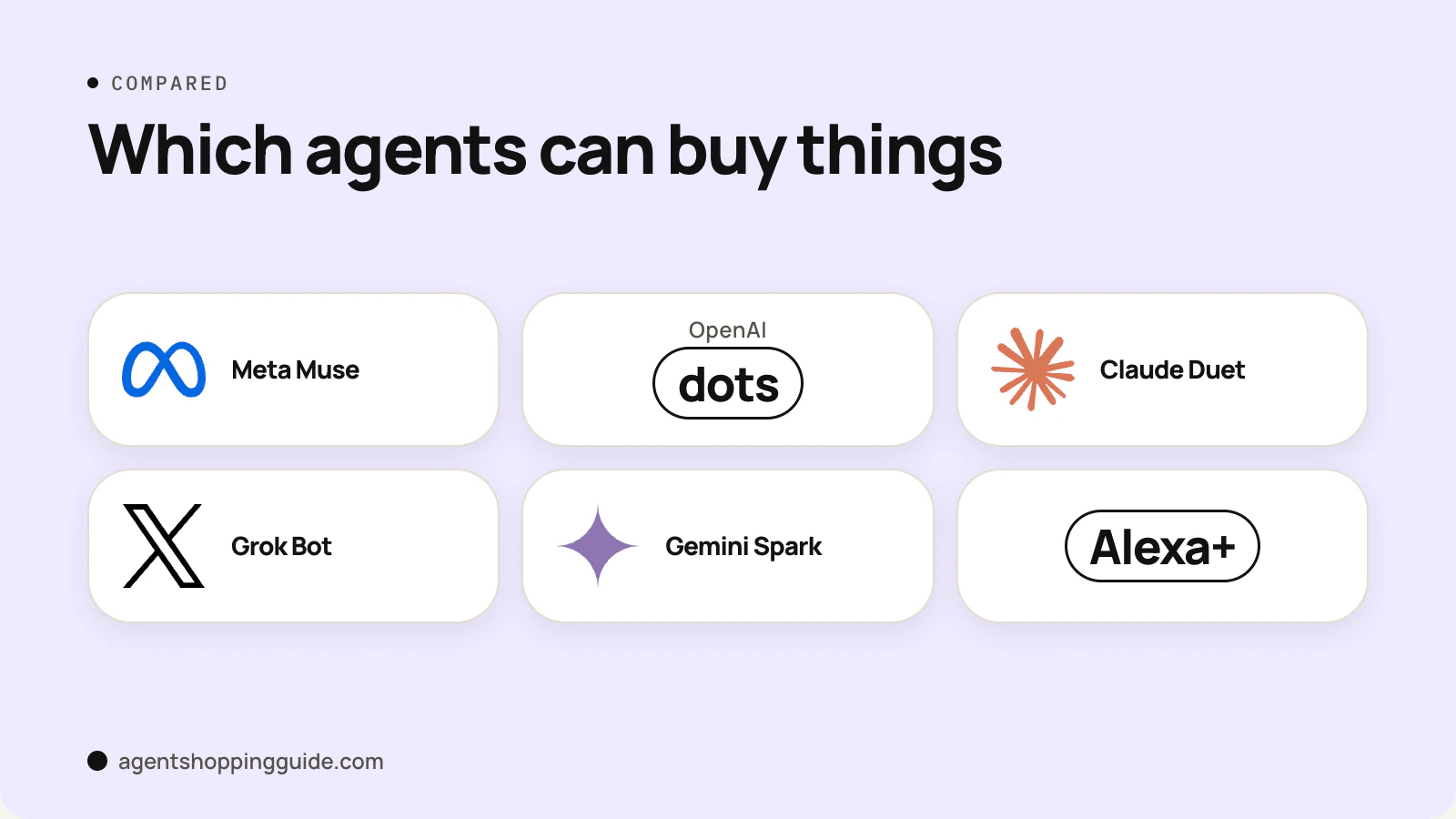
For agents that can check out, such as Meta Muse, Claude Duet and OpenAI dots. See which AI agents can buy things for what each supports.
Buy a replacement water filter for my fridge, model number on the attached photo. Only the manufacturer's filter or one certified to NSF 53, no unbranded listings. Total under $55 delivered. Must arrive by Thursday. Use Target, Home Depot or the manufacturer's site. Before paying, show me the exact listing, total price and delivery date, and wait for my OK.
Most of the main agents build approval in anyway. Meta requires approval for every Muse purchase. Anthropic's Duet safety article says Duet always asks before paying and cannot be set to "don't ask me again" for payments, and Duet pays with a one-time card limited to one merchant and amount. Grok Bot lets you add "Ask first" rules for purchasing, according to its FAQ. The brief still helps, because it tells the agent what to show you at the approval step.
- Your brief
- Agent searches and compares
- Shortlist with links
- You approve one
- One-time card or wallet pays
Template 3: Buy when the price drops
Price-triggered buying is the most autonomous thing agents do today. Google's agentic checkout tracks a product with your size, colour and budget and can buy it with Google Pay when the price drops, after you confirm purchase and shipping details. Amazon's Alexa for Shopping uses the example "Purchase this t-shirt when it's $15 or less" and says it can complete the purchase with your default payment method. Amazon's how-to page does not say whether you confirm before the auto-buy goes through, so check the prompt you see.
Watch the Le Creuset 5.5 qt round Dutch oven in Marseille blue. Buy it only if the price from Le Creuset, Williams Sonoma or Sur La Table drops to $300 or less, delivered. Stop watching after 31 December. Message me before you pay.
More in AI price tracking.
Template 4: Gifts
Gifts need recipient details the agent cannot know, and a hard delivery date.
Find a gift for my sister, 34, who runs trail half-marathons and already owns a Garmin watch. Budget $60 to $90 including gift wrap and shipping. Must arrive at her address in Denver by 18 December. No clothing, since I do not know her size. Show me three ideas with a one-line reason each, then wait.
Our AI gift shopping guide covers delivery cut-offs and gift receipts.
Which words cause the most mistakes?
| Vague phrase | What the agent might do | Say instead |
|---|---|---|
| "Cheap" or "good value" | Pick the lowest price, any seller | A budget ceiling and acceptable stores |
| "Same as last time" | Guess from memory or an old order | The model number or a link |
| "Medium" | Use one brand's size chart | Your measurements or a brand size you know fits |
| "ASAP" | Pay for express shipping | A date and a shipping budget |
| "Best one" | Choose by review count | Your two or three priorities |
| "Just get it" | Skip the shortlist | "Show me before you pay" |
How should you set limits outside the brief?
A brief is instructions, not a guarantee. Back it up with settings:
- Spending caps in the payment wallet or on the card, since most agents don't offer a dollar cap in their own settings. See AI agent spending limits.
- One-time or virtual cards, so a mistake is capped at one purchase. See setting up a virtual card for agent purchases.
- Approval for every purchase, which most major agents require or offer. Amazon doesn't document a final confirmation for target-price auto-buys.
Agents read web pages as they shop, and a page can contain text designed to steer them. A tight store list in your brief reduces that exposure. For why this happens, see prompt injection explained.
What if it still gets it wrong?
Returns go through the store that sold the item, which is the merchant of record in ACP, UCP and Amazon's Buy for Me. Keep the order confirmation the agent receives, and follow our guide to returning something your AI agent bought. If a charge appears that you did not approve, contact your card issuer promptly.
Bottom line
Write briefs like you would for a careful assistant on their first day: exact item, deal-breakers, total budget, deadline, trusted stores and a stop rule. Ask for a shortlist, read the one-line summary at approval and keep spending limits in place.