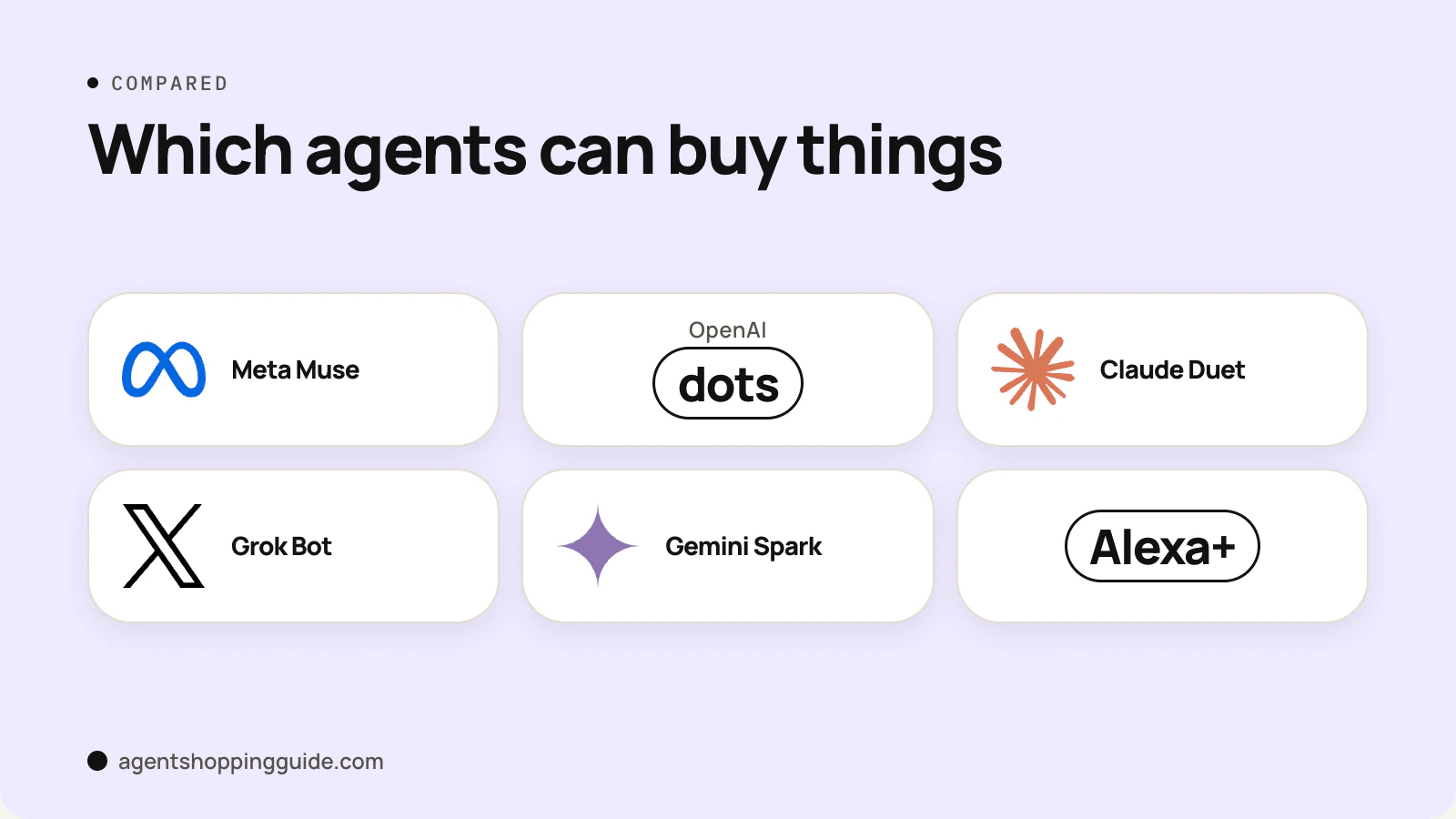
Several AI agents can now finish a purchase for you, but far fewer than the marketing suggests, and almost every one we track documents an approval step. The exception is Amazon's target-price auto-buy, where Amazon's page doesn't say whether you confirm first. As of November 2026, the agents that can actually complete checkout are Meta Muse, Claude Duet, Amazon's own shopping assistant, Google's agentic checkout and Perplexity's PayPal checkout. ChatGPT has stepped back to research and referrals, and Grok Bot hands the payment step back to you.
This guide is based on each vendor's documentation and launch coverage. We have not made test purchases with any of these agents.
The short answer: who can check out?
The useful question is not "can it shop?" but "can it pay, and where?" Most agents can compare products. Fewer can put an item in a cart. Fewer still can enter payment and place the order. (If those three levels are new to you, our explainer on assistants versus agents breaks them down.)
- Agent families that can complete checkout (Nov 2026)
- 5
- Agent family that can buy on Amazon.com (Amazon's own)
- 1
- Muse and Duet ask for your approval
- Every purchase
- Where almost all agent checkout works today
- US
| Agent | Can it pay? | How it pays | Approval | Where it works | Amazon.com |
|---|---|---|---|---|---|
| Meta Muse | Yes | Single-use Link by Stripe cards; Shop Pay now listed by Shopify | Every purchase | US, Canada, Japan, Singapore | Blocked since 20 Sep 2026 |
| Claude Duet | Yes | Link or Shop Pay one-time cards, one merchant and one amount | Always; can't be switched off | US only, waitlist | Not documented |
| Alexa for Shopping | Yes | Your Amazon default payment method | Not stated for target-price auto-buy | US only | Yes |
| Amazon Buy for Me | Yes, on brand sites | Amazon passes encrypted card details | Amazon checkout page | US beta, subset of users | n/a (it is Amazon) |
| Google agentic checkout | Yes, for tracked items | Google Pay | "Only buy after you've confirmed" | US, eligible merchants | No |
| Perplexity shopping | Yes | PayPal | You check out in the conversation | US, free | Disputed in court |
| ChatGPT | Mostly no (since March 2026) | Merchant's own checkout or retailer apps | You pay the merchant | US for apps | No |
| OpenAI dots | Reported | Saved card | Saved-card purchases need approval | Pro and Business Premium markets | Not documented |
| Grok Bot | You do the payment step | Takeover flow | "Ask first" rules available | No country list | Amazon blocks Grok user agents (amazon.com and amazon.co.uk) |
All rows are as of November 2026.
Agents that complete the purchase
Meta Muse
Muse is the most retail-focused of the general personal agents. Meta's launch post says purchases use single-use cards generated by Link by Stripe, that Muse "never sees" your real card details, and that every purchase needs your approval. Meta calls Muse the first AI agent covered by Link's purchase protections. Meta listed Shop Pay and 1Password as "coming soon" at launch; Shopify's Fall '26 Edition now lists Shop Pay checkout in Muse.
Retail Gazette reported Walmart, Best Buy, Gap and Sephora as US retail partners; Meta has not published its own partner list. The big gap is Amazon, which blocked Muse on 20 September 2026. Full detail is in our Meta Muse shopping guide.
Claude Duet
Anthropic's Duet, in research preview since 21 October 2026, pays through Link or Shop Pay, both set up inside the app. Anthropic's safety article says each purchase uses a one-time card limited to a single merchant and amount, and that paying or sending money, deleting an order and creating an account can never be moved to "don't ask me again". It needs a US Claude Pro, Max or Ultra plan and a waitlist invite, and DataCamp reports that Link purchases in Duet need a US payment method. See shopping with Claude Duet.
Amazon: Alexa for Shopping and Buy for Me
Inside Amazon, the agent is Amazon's own. On 13 May 2026 Amazon merged Rufus and Alexa+ into Alexa for Shopping, free to any signed-in US customer. It can track prices against up to a year of history and "buy items at your target price" using your default payment method. Amazon's how-to page does not say whether you get a final confirmation before an auto-buy goes through, so treat it as possible that it doesn't. Our Alexa for Shopping guide covers the settings.
Buy for Me, a beta since April 2025, goes the other way: Amazon's agent buys from other brands' own websites. You confirm on an Amazon checkout page, Amazon sends your encrypted name, address and payment details to the brand, and the brand then handles delivery and returns. See Amazon Buy for Me.
Google agentic checkout
Google announced agentic checkout on 13 November 2025. You track a specific product, with size, colour and a maximum price, and when the price falls into range Google can buy it on the merchant's site with Google Pay. Google's wording: "We'll always ask for your permission first, and only buy after you've confirmed the purchase and shipping details." Named merchants were Wayfair, Chewy, Quince and select Shopify stores, US only. Gemini Spark, Google's always-on agent, asks before purchasing, but Google hasn't documented how spending confirmation works. More in Gemini Spark and Google's agentic checkout.
Perplexity
Perplexity launched free shopping for US users on 25 November 2025, with checkout through PayPal inside the conversation. The retailer stays the merchant of record and handles returns. Its Comet browser can also act on sites, which is the subject of Amazon's lawsuit. See Perplexity and Comet shopping.
Agents that research but mostly hand off
ChatGPT
ChatGPT launched Instant Checkout with the Agentic Commerce Protocol on 29 September 2025, then scaled it back in March 2026. Sources disagree on the exact date (4, 17 or 24 March). OpenAI told Retail Gazette the first version "did not offer the level of flexibility that we aspire to provide". ChatGPT now leans on discovery: you compare in the chat, then pay on the merchant's site or in retailer apps such as Instacart and Target. Details in ChatGPT shopping research.
ChatGPT agent mode and dots
Agent mode browses sites in its own browser, and Cloudflare lists "ChatGPT agent" as a signed agent. OpenAI's dots, launched 29 September 2026, need your approval for purchases on a saved card, and money transfers always come back to you. A line saying a dot "can buy things for you with your approval" comes from a leaked string, not an OpenAI page. We cover what is and isn't documented in ChatGPT agent mode and dots.
Grok Bot
xAI's Grok Bot works on a cloud computer and can browse stores, but its docs say steps that need a human, including payments, passwords and CAPTCHAs, are handed to you through a takeover flow. You can also add "Ask first" rules for purchasing. No retailer partnerships are documented. Shopify's Fall '26 Edition names Grok Bot in its Shop Pay copy, but the page's footnote lists only Muse, Instinct and Claude Duet, and xAI's docs don't mention Shop Pay, so treat Grok Bot Shop Pay support as unconfirmed. See Grok Bot shopping.
How the payment actually happens
Agent checkout comes in roughly three patterns, and they matter for refunds.
- You approve
- Agent wallet (Link, Shop Pay, Google Pay, PayPal)
- Single-use or scoped card
- Merchant of record
- Your order
- Wallet with one-time cards (Muse, Duet). The agent gets a card that only works for that purchase, so a mistake can't run up further charges on your real card.
- Platform wallet (Google Pay, PayPal, Amazon). The platform completes the payment with a stored method. Buyer protection follows that platform's rules. PayPal says its buyer protection applies to its agent checkouts.
- Handoff (ChatGPT referrals, Grok Bot takeover). You pay yourself on the retailer's site.
In every pattern we found, the retailer remains the merchant of record. That means returns go to the store, not the agent maker. Our guides to agentic checkout and spending limits go deeper, and returning something an agent bought covers the after-sale side.
Where can these agents shop?
The biggest constraint is the store, not the agent. Amazon's Conditions of Use require shopping agents to identify themselves as "Agent/[name]", and amazon.co.uk's robots.txt disallows 99 named AI agents, including ChatGPT, Claude, Perplexity, Meta and Grok user agents. Amazon blocked Muse in September 2026 and sued Perplexity over Comet. Meanwhile Walmart, Target, Etsy, Wayfair and Shopify co-developed Google's Universal Commerce Protocol, and Target, Instacart, DoorDash and Expedia run apps in ChatGPT. Our store-by-store policy guide tracks who allows what.
Which one should you use?
Pros
- Muse or Duet if you want an agent that pays with a card that dies after one purchase
- Alexa for Shopping if most of what you buy is on Amazon
- Google agentic checkout if you mainly want to buy a specific item at a lower price
- Perplexity if you want search-style research with PayPal checkout on supported US products
- ChatGPT if you want research first and are happy to pay yourself on the merchant's site
Cons
- Nothing here buys across Amazon and the open web in one agent
- Almost every checkout feature is US only as of November 2026
For a broader look at these agents beyond shopping, including email and calendars, see the independent reviews at getpersonalaiagents.com. UK readers should check which agents work with Amazon UK, since most of the tools above are not live there.
Bottom line
An AI agent that can buy things for you exists, but it is narrower than a human personal shopper. In November 2026 the realistic options are an Amazon tool for Amazon, Muse or Duet for approved one-off purchases at stores that don't block them, and Google or Perplexity for checkout from search. Whatever you choose, keep approvals on, and write a clear brief: our guide on what to tell a shopping agent helps it pick the right item first time.